
Are you interested in learning more about participating in research? – Fill out this form .
Click here to view our YouTube video entitled Syracuse University Aphasia Lab: Recruiting Now for Brain Stimulation Fatigue Study.
Brain Stimulation Fatigue Study
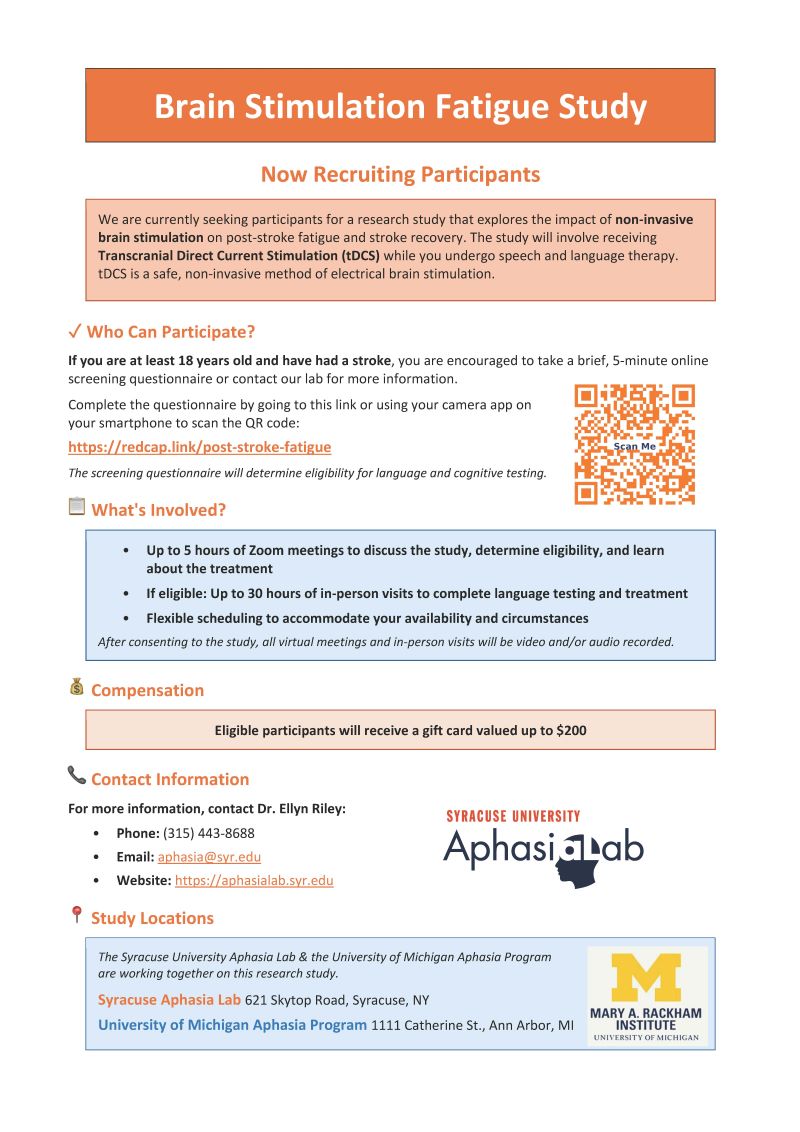
The Syracuse University Aphasia Lab in New York and the University of Michigan Aphasia Program are recruiting participants for a research study investigating brain stimulation to help reduce fatigue and improve language and cognitive recovery for people after a stroke. Transcranial Direct Current Stimulation (tDCS), a safe non-invasive type of electrical brain stimulation, will be used while participants receive speech and language therapy. Individuals who are 1) at least 18 years old, 2) have had a stroke, and 3) have experienced speech/language difficulties following their stroke are invited to take a brief, 5-minute screening questionnaire to determine eligibility for language and cognitive testing. The questionnaire is available by going to https://redcap.link/post-stroke-fatigue.
If eligible based on screening questions, the participant will be invited for a virtual Zoom meeting with a research team member to discuss the study and complete the informed consent process. Should they want to continue, language and cognitive testing will be administered over Zoom to determine eligibility for treatment. If determined to be eligible, participants will be asked to complete up to 15 hours of in-person testing and up to 15 hours of in-person treatment. Our research team will work to accommodate participants’ scheduling constraints and individual circumstances when arranging in-person visit times, with the goal of maximizing accessibility for all participants. Eligible participants will be compensated up to $200 for completion of the study. To learn more about the research, please contact Dr. Ellyn Riley at (315) 443-8688, or visit aphasialab.syr.edu, or complete the interest form above.
The Aphasia Lab is located on the Syracuse University South Campus at 621 Skytop Road in Syracuse, NY; the University of Michigan Aphasia Program is located at 1111 Catherine St. in Ann Arbor, MI.
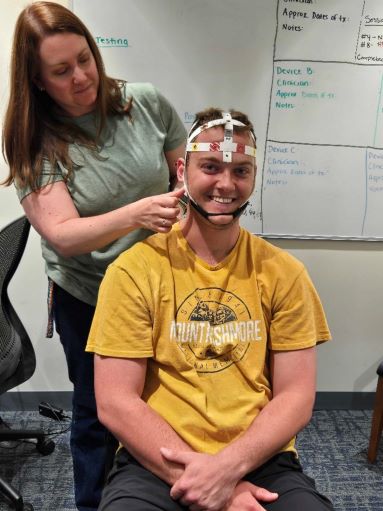
electrode positioning for the new brain stimulation fatigue study.
